
Every CRM Is Agentic Now. So Why Are Sellers Still Doing Admin?
Every CRM ships AI agents now, yet sellers are still stuck doing admin. Here is what an agentic CRM should actually do, and why trust and context matter.

Every CRM wants to be agentic now. Salesforce has Agentforce, HubSpot has its Breeze agents, Attio calls itself AI-native and Pipedrive has added an AI assistant. It has become the thing to have, and we get why.
An agentic CRM is one where AI agents do the work of the pipeline, such as updating records, preparing meetings and drafting follow-ups, inside limits the team sets. AI that only summarizes and suggests is AI-assisted, not agentic. The test is simple: does anything happen when nobody is logged in?
According to Salesforce's own State of Sales report, 54% of sellers have used AI agents. That is lower than it should be. Most people just haven't seen what a good agent can do yet. The time hasn't been freed up either. Reps still spend 78% of their week on things that aren't selling.
Part of the problem is the data underneath. Gartner predicts that 60% of AI projects without AI-ready data will be abandoned, and as we'll get to, CRM data is rarely ready for anything.
At the same time, sitting it out is not an option. Sellers who work well with AI are 3.7 times more likely to hit quota. Soon every seller will work with an AI assistant. The question is whether it helps them sell or just adds another tab.
What should an AI sales assistant actually do?
It should follow the seller through the whole day and take work off it, not add another tab to check. Most AI tools do the opposite and add more content. More summaries, more dashboards, more notifications and another tab to keep open. A Salesforce survey found that sales teams already use around 10 tools to close a deal, and 66% of reps feel overwhelmed by them. That matters, since studies show that overwhelmed sellers are 45% less likely to hit quota.
What a seller really needs is one assistant that follows them through the whole day. Before a meeting you should get a short brief on who you are meeting and what has happened since last time. During the day it should tell you what's due, who to call and which emails need to go out, and after the meeting the follow-up should already be drafted in your own style, with the CRM updated.
The important part is that you don't get all of it at once. Sellers don't want everything, they want what they need right now, put right in front of them.
One of our customers now has 70 customer meetings a week with zero CRM admin, and that doesn't come from reading more summaries.
How do sales teams learn to trust AI agents?
Trust in an AI agent builds in steps. You let it do something small, then something bigger once it proves itself, and you keep the final say. None of this works without that trust, and trust is tricky. Researchers who study trust in automation break it down into three questions. Does it work, can I understand how it works, and is it trying to do what I want? You don't get the answers at once. Trust builds with experience.
That matches how most of us have started trusting AI.
You don't need to see every decision it makes. You need to know you could.
That trust is also fragile. People tend to give up on a system after seeing it make one mistake, even when it's still better than they are. But they keep using it when they have a say in the result. So being in control matters as much as the system being right.
I noticed this myself earlier this year, when I spent a week living with an AI boss that decided when I ate, slept and worked. It made me more productive, but it also showed me how easy it would be to just follow whatever the AI says. Work is going to change, and I want AI that lets us flourish, not AI that controls us.
That's the line we try to hold at Spiich. You should be able to track what the agent decided and why, for example which leads it kept and which it dropped. You stay in control, your own edits always win, and nothing goes out without you.
Why is CRM data wrong, and can agents fix it?
CRM data is usually wrong because it is typed in from memory, and agents can fix that by filling it in from the actual meetings and emails.
CRMs are great. They give the whole company one view of its customers and the funnel, from how many deals sit in each stage to what actually converts. But that view is only as good as what's in the CRM.
And what's in the CRM is usually not great. Reps spend around 5 hours a week on data entry, yet 76% say less than half of their CRM data is accurate and complete. In the same survey, 37% said they have lost revenue because of poor data, and 37% said people regularly make data up to tell leaders what they want to hear.
That makes sense when you think about how the CRM gets filled in. It happens from memory, often on a Friday afternoon, days after the meeting. An agent can fill it in from the actual meeting and the actual emails, right after they happen.
It works the other way too. A CRM holds a lot of data, and most of it doesn't matter for the deal you're working on right now. A good agent finds the right parts, the contacts, notes and earlier deals that are relevant, and leaves the rest.
Most tools only do one piece of this. Granola does notes, Clay does lists and Attio fills in fields with AI. You can also wire it all together yourself, but that's more work than it looks. We build it as one system, because the context lives in the connections between the pieces.
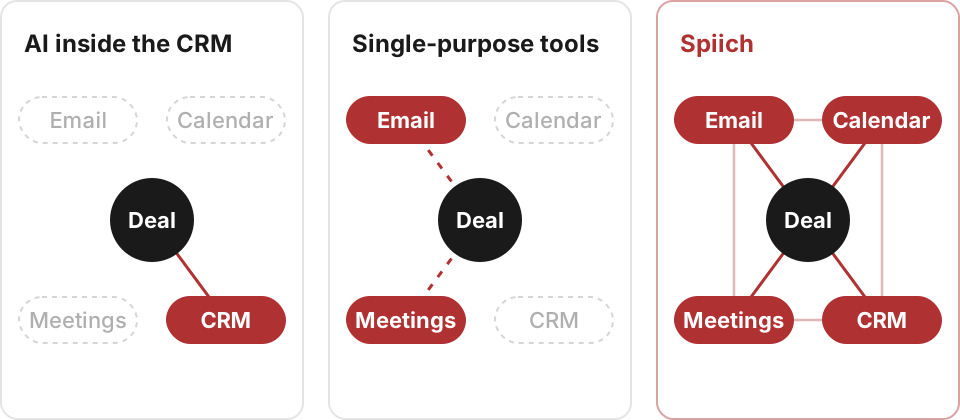
What to ask before buying AI for sales
If you're looking at AI for your sales team, ask three things. Where does it get its context? Can you see what it decided, and why? And can you override it?
Let the AI do the admin. The selling is still yours.
Frequently asked questions
One assistant for the whole sales day
See how Spiich prepares your meetings, drafts your follow-ups and keeps the CRM current, with you in control.
Book a demo